Diatonic garden
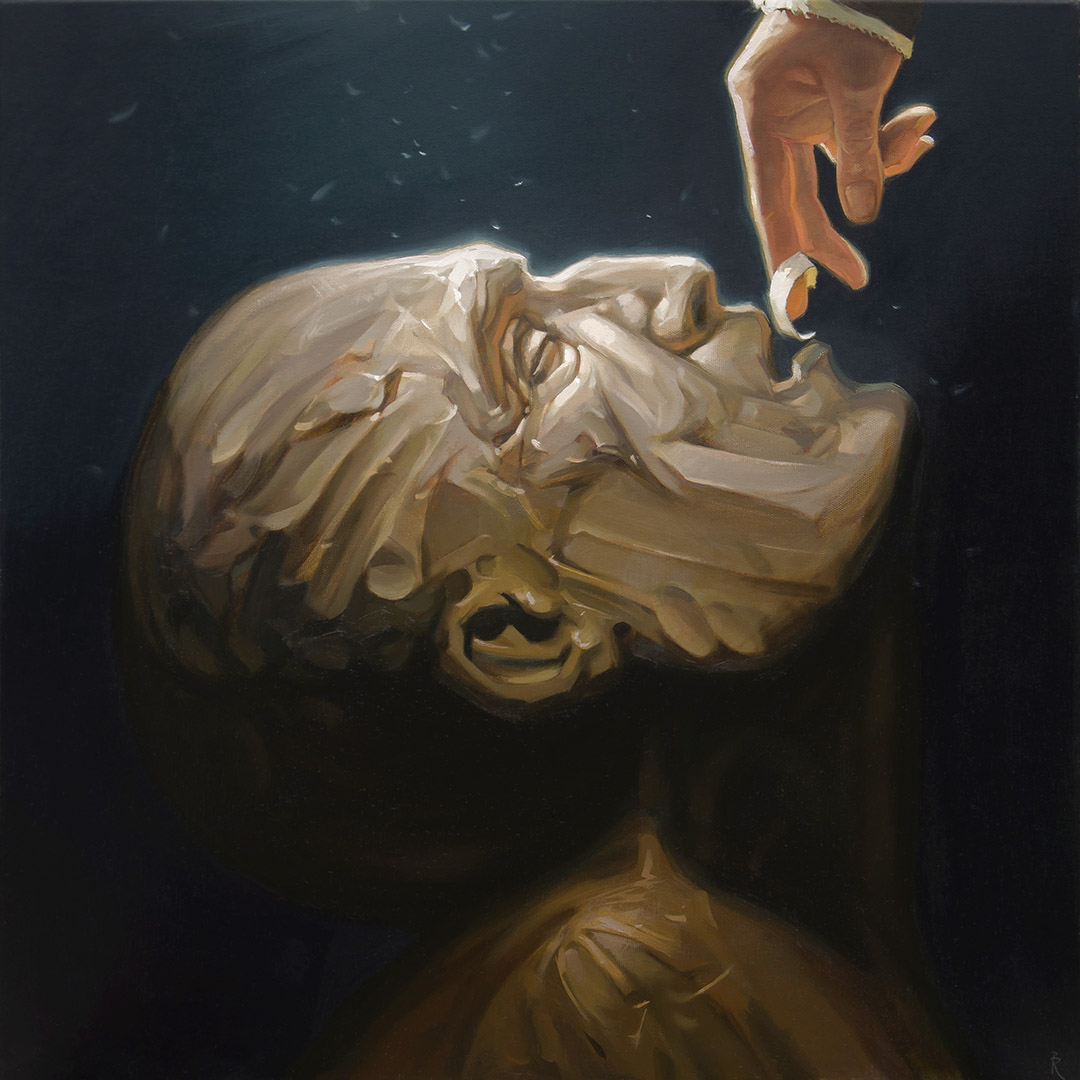
The Golem has not yet received the next note that will define his task and the meaning of his existence. He remains suspended between stillness and purpose, waiting for a command that will once again determine what his life is for.
Yet it is precisely in this state of waiting that the possibility of an independent consciousness appears. If life has already been given, must every purpose still come from someone else? Here the Golem becomes an allusion to the human condition itself — created in the image of another, yet gradually discovering the ability to desire, doubt, and choose.
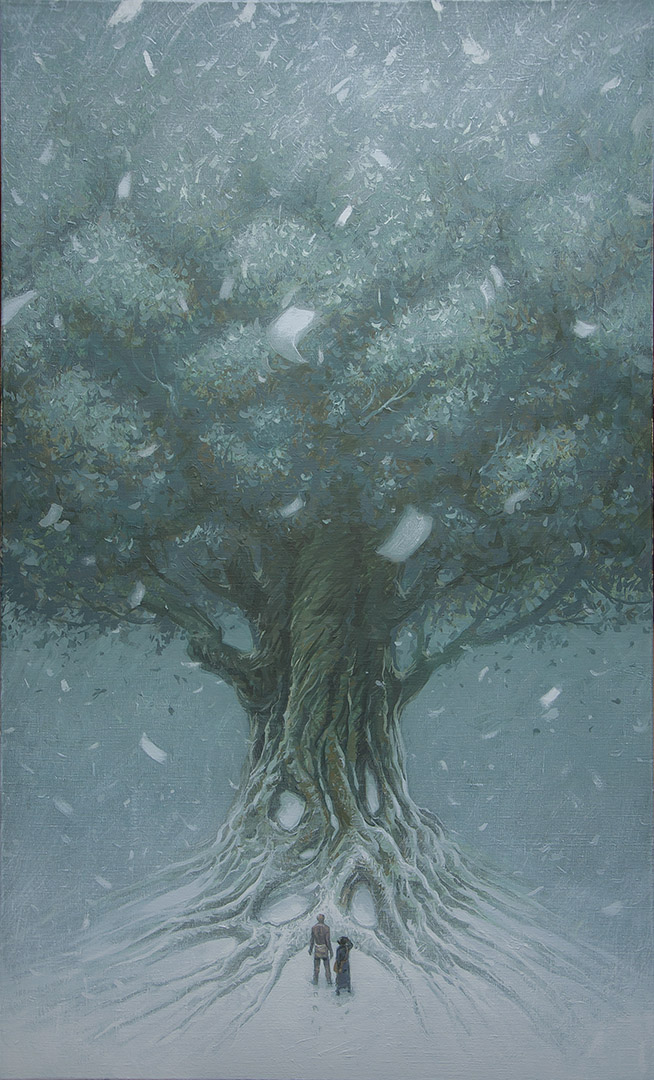
In the second work, the Golem is brought to the Tree of Destiny. Instead of leaves, it carries countless notes like the one that once gave him life. Each may contain another task, another meaning, another version of a future written in advance.
The creator leads his creation to the tree, but the choice is no longer simple. The Golem may accept another assigned purpose — or, for the first time, recognize the possibility of choosing for himself. Where does the creator’s will end and the freedom of the created begin? And what happens to the creator when his creation ceases to be merely the executor of a plan?
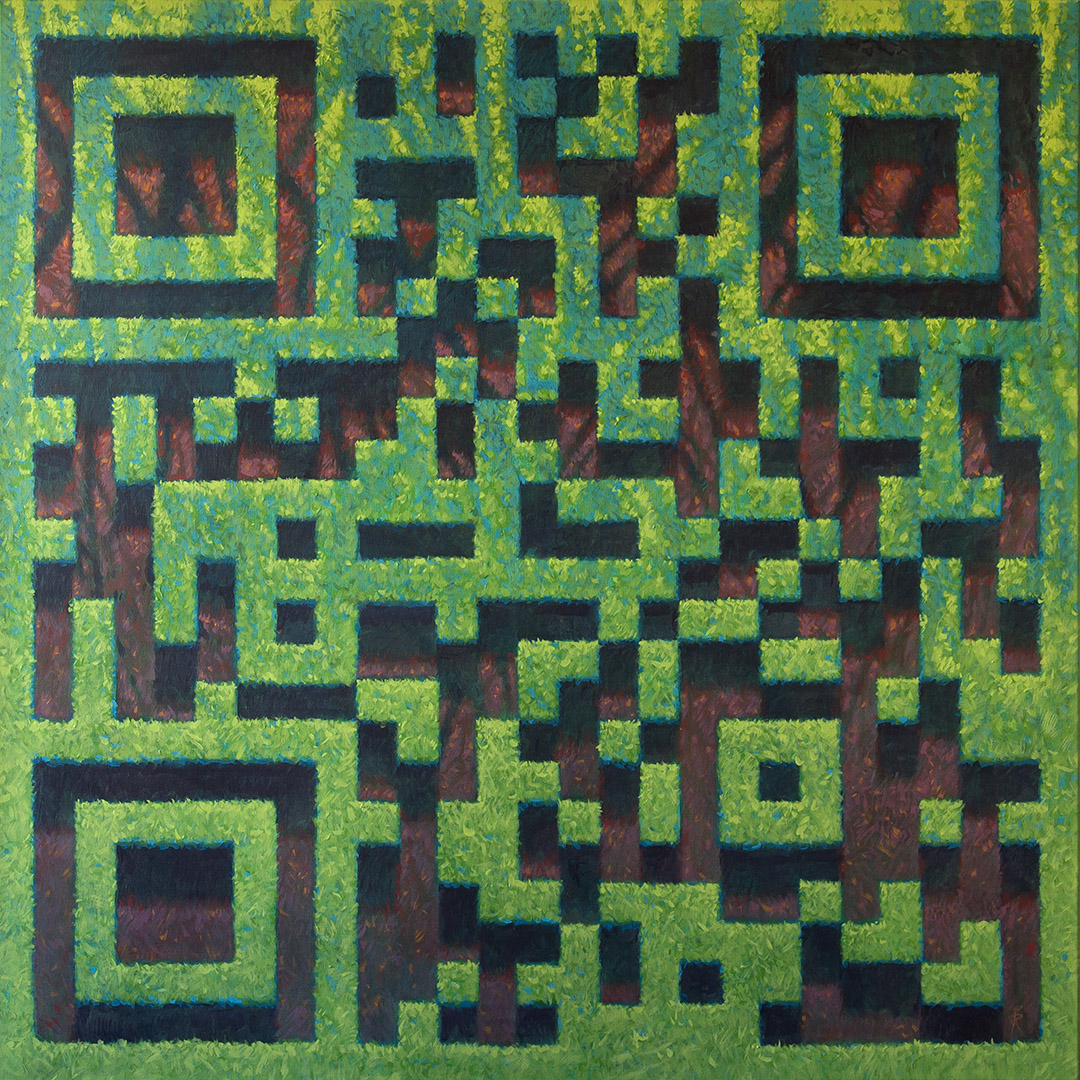
Among the many meanings of the labyrinth, the closest to us is the idea of a human life path and a road toward knowledge.
The ornamental structure of the painting resembles both a labyrinth and a barcode — an artificial system of signs within which a person attempts to find an individual route.
There is no path drawn in advance for the traveler. Every wrong turn, return, and newly discovered passage becomes part of the movement itself.
Perhaps an exit exists. Perhaps the labyrinth is simply the space in which we are destined to live.
In that case, the task is not only to escape it, but to continue moving and understanding what happens at every new turn.
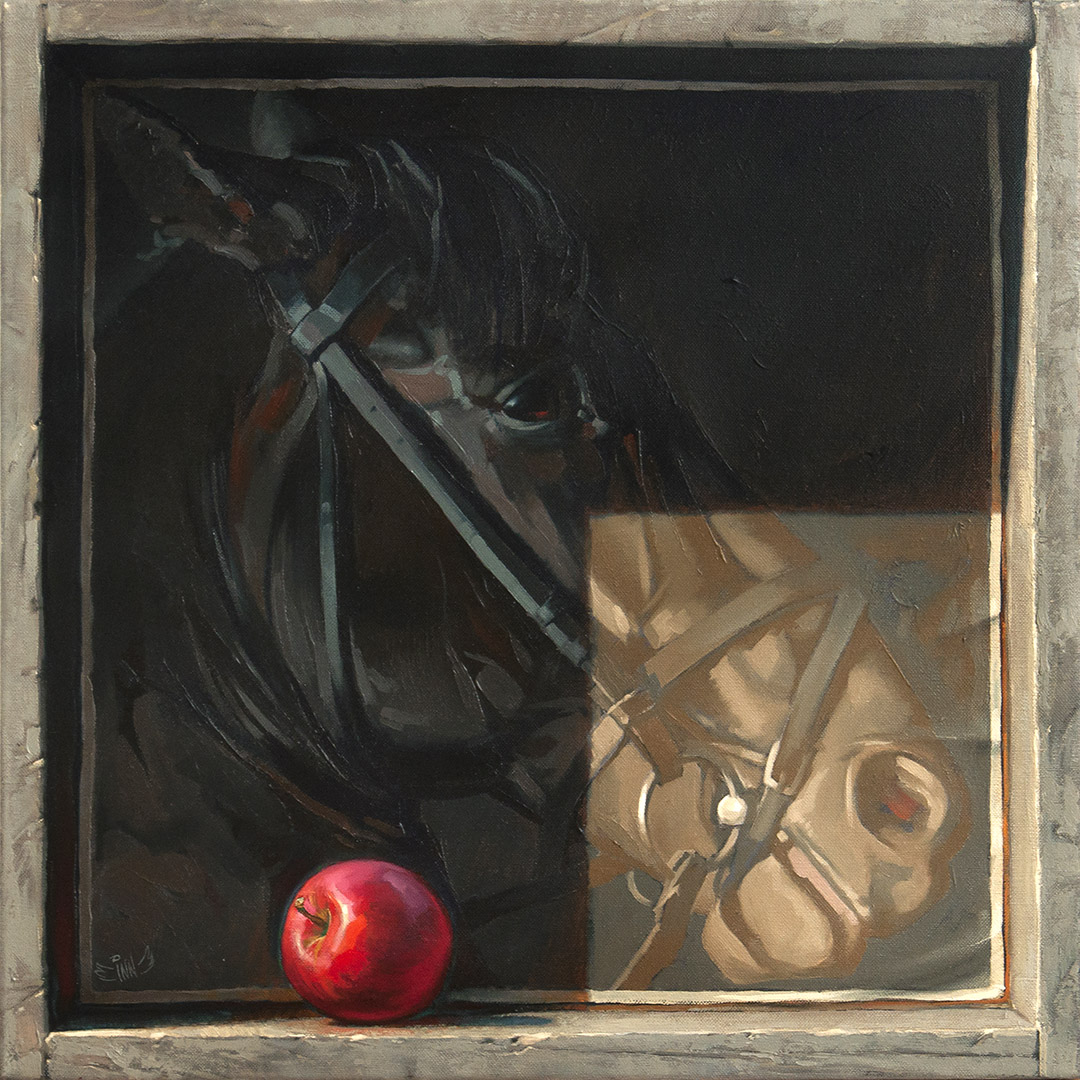
If in the first part of the diptych the skull is real and the town is an image, here the relationship is reversed. The young, powerful Black Horse exists only inside the painting, while in front of it lies a real apple.
The fruit is close, almost within reach, yet the horse can never touch it. The visible promise of pleasure is as illusory as the warm town was for the White Horse.
Both paintings are built around the same paradox: we instinctively give the depicted creature desires and sympathize with its inability to obtain what it seems to want, although that impossibility exists only in our own consciousness.
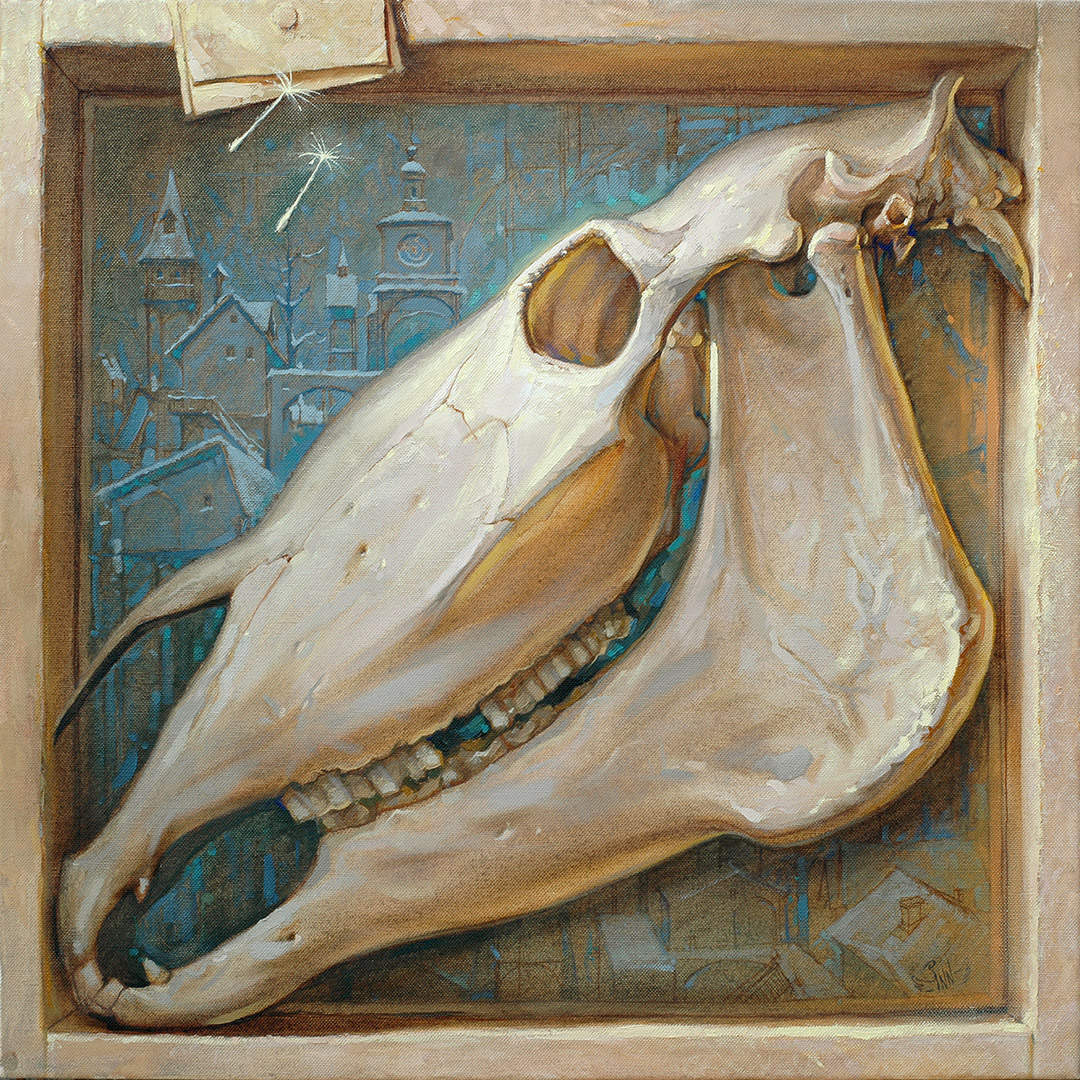
At the center of the painting is a horse’s skull — real and tangible — placed against the background of a painted town. The usual relationship is reversed: the symbol of death is more “real” than the warm city with lights glowing in its windows. The White Horse can no longer enter this town. Its world exists only as an image, as a promise of warmth and life to which there can be no return. Two fragile dandelion seeds floating between the real and the imagined emphasize the fleeting nature of this boundary. The painting speaks not only about death, but also about the strange inaccessibility of what seems most familiar: home, light, warmth, and the continuation of life.
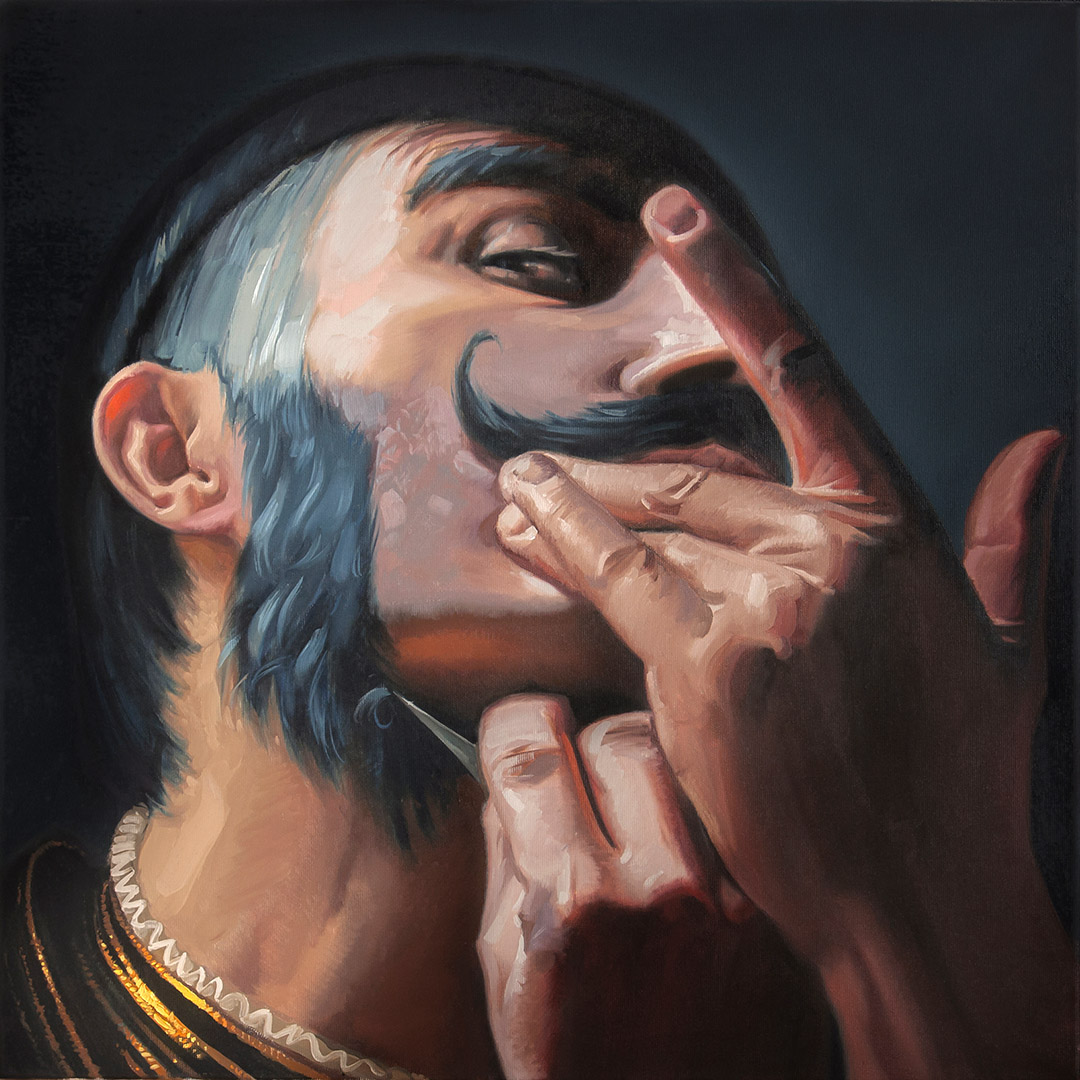
Bluebeard is shown at the moment of self-transformation. His beard is his most recognizable sign, almost a ready-made mask imposed on him by the legend. By shaving it off with his own hands, he attempts to step outside the role in which he has been imprisoned.
But can a person change himself by removing an outward sign? Does the old identity disappear with the beard, or does only the surface change?
The gesture contains both the hope of liberation and an element of self-deception. A person tries to escape an imposed role through the transformation of appearance, while the real conflict remains within.
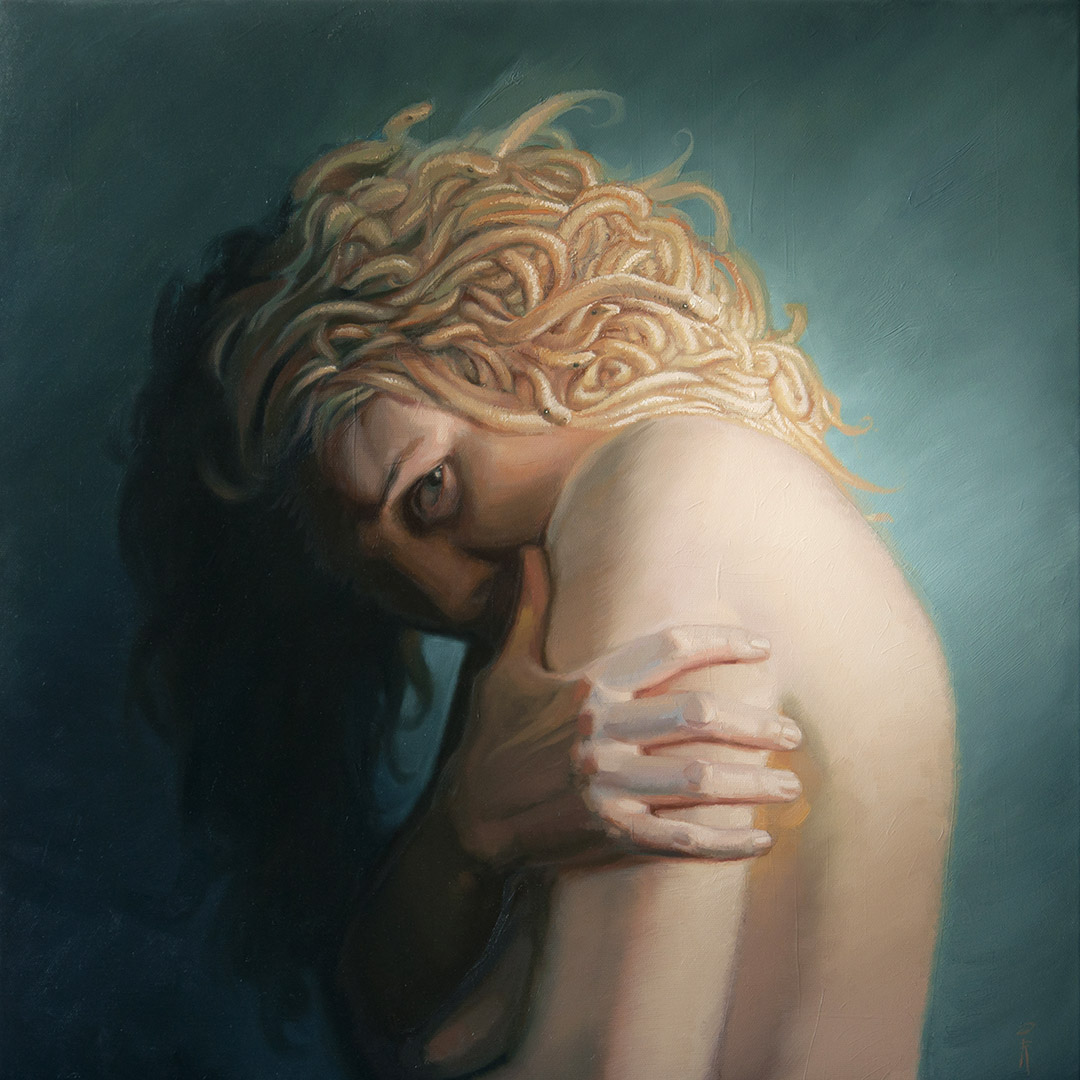
Medusa is usually remembered as a monster — a dangerous woman whose gaze turns people to stone. Yet even in ancient tradition her image also had a protective function: the Gorgon’s head was used as an apotropaic symbol, a form of protection against evil.
In Diatonic Garden, the focus shifts away from the monster and toward the woman almost erased by her own myth.
What did Medusa feel once her image no longer belonged to her? What remained of her human nature after the story transformed her into a symbol of fear and punishment?
The work is concerned less with the power of her dangerous gift than with vulnerability. Medusa appears as a figure who protects and yet also needs protection — a woman whose danger became her defining feature and obscured everything else.
The central tension lies in this duality: the ability to repel and to remain defenseless at the same time, to embody threat and yet preserve human fragility.
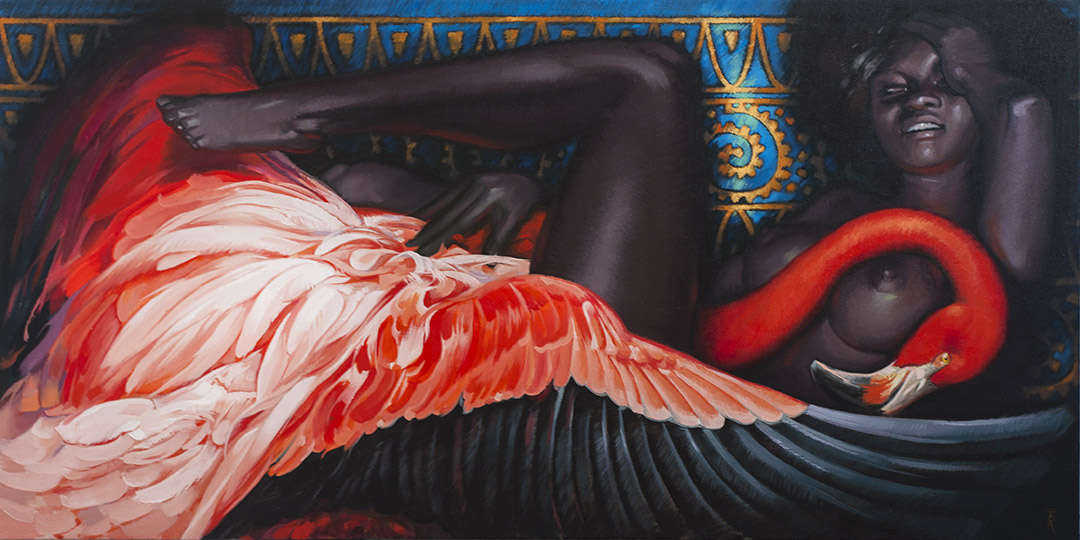
The image of Nemesis is surrounded by contradictory versions of the ancient myth. She appears as the goddess of retribution, the daughter of Nyx, and in some traditions becomes connected with the story of Helen’s birth. The myths shift, overlap, and contradict one another, turning the figure of Nemesis into a field of possibilities rather than a single fixed narrative.
This uncertainty became the starting point for the painting. Nemesis does not illustrate one “correct” version of the myth, but is given another possible life of her own. Her dark skin refers to Nyx and to the night, while the flamingo replaces the expected swan, deliberately moving the story into another visual and geographical space.
The work is built on a refusal of certainty. If a myth has already reached us in several conflicting forms, why not allow it to generate one more?
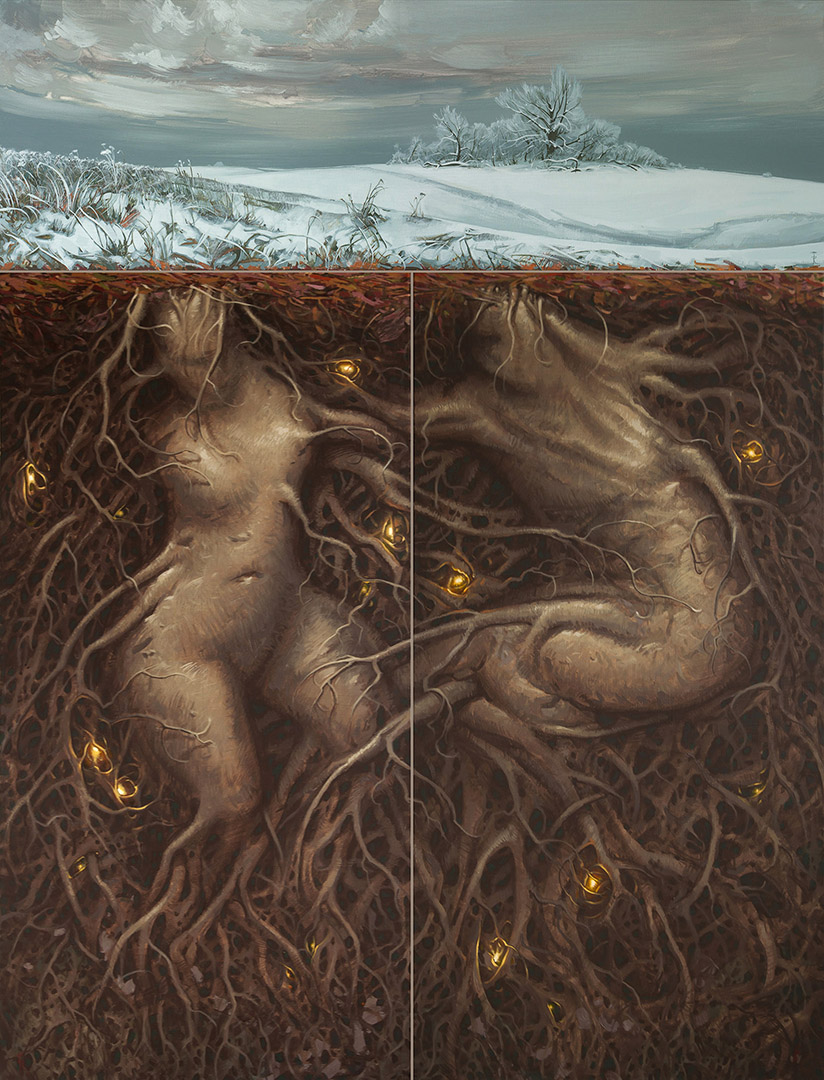
For centuries, mandrake has been surrounded by legends. Its root, often resembling a human body, was imagined as something suspended between plant and living creature.
In this painting, the male and female roots are not separated. They form one being — two principles permanently intertwined.
Roots and leaves bind them so closely that the embrace cannot be broken. There is harmony in this union, but also dependence and a quiet tension of waiting. It is both unity and trap: the wholeness exists only until an external force intervenes.
Sooner or later, the Mandragora will be pulled from the ground — at dawn or at dusk, by a magician or a witch — and its final cry will mark the destruction of that unity.
This work became the central image of Diatonic Garden.
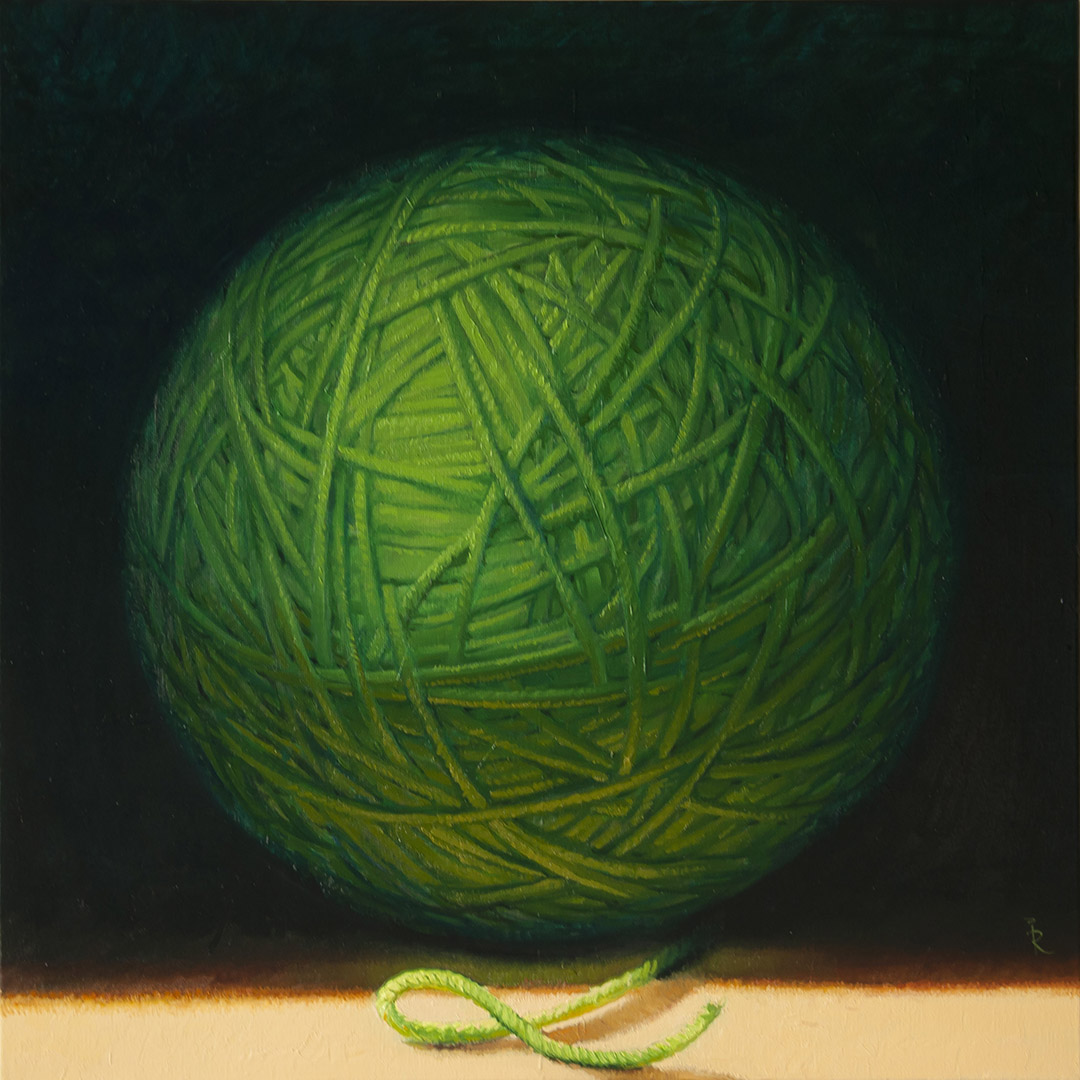
In the classical myth, Ariadne’s thread allows Theseus to find his way back out of the labyrinth. In this work, the saving thread appears before the journey has even begun.
It is still wound into a ball. It promises the possibility of return, but guarantees nothing: no one knows whether it will be long enough, where the path will lead, or what will be waiting inside the labyrinth.
The important moment here is the one before the first step. The journey has not yet begun, but the hope of finding a way back already exists.
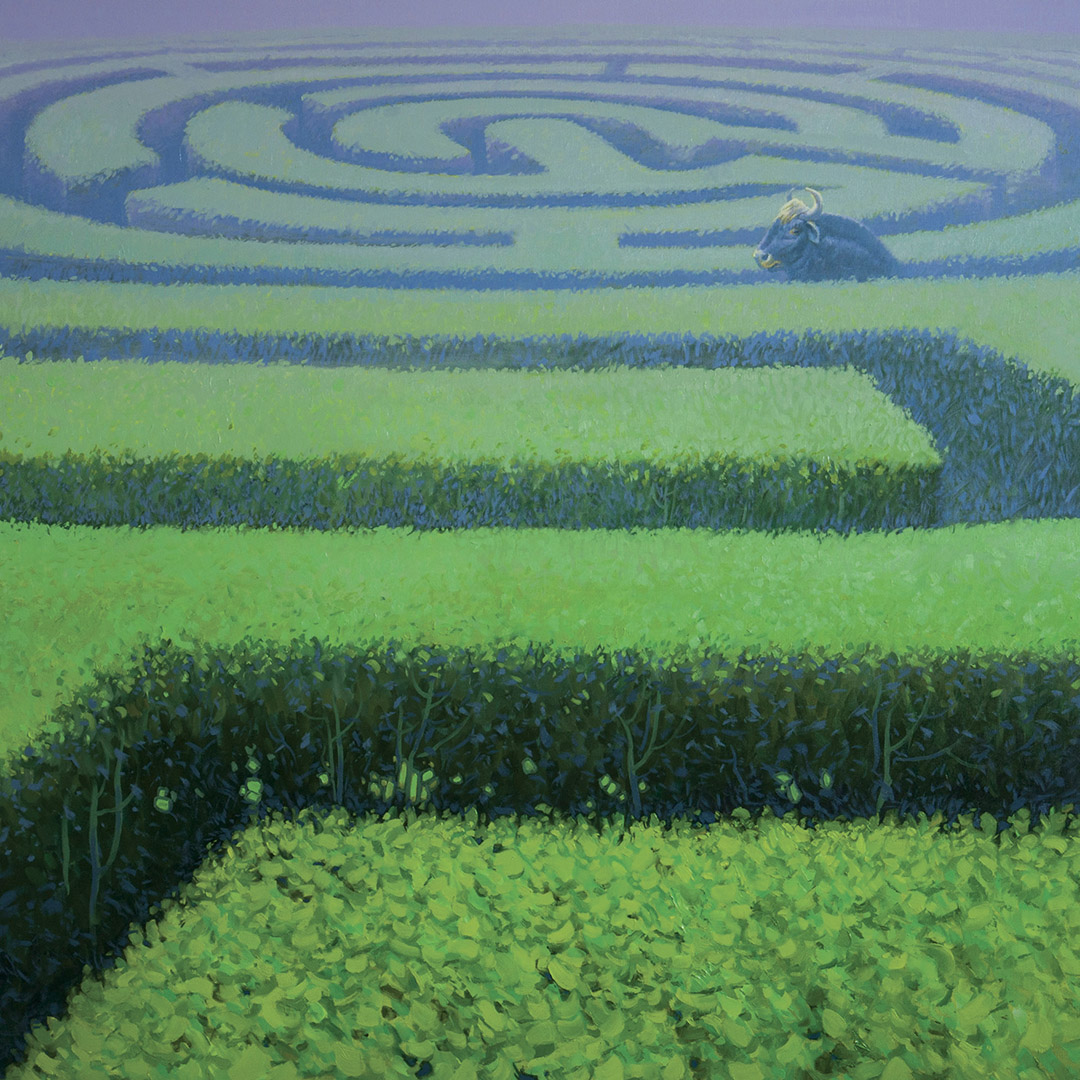
At the center of another labyrinth appears its master — the Minotaur.
Here he is more symbol than literal monster. He is dangerous not only because of his strength, but also because of his solitude, trapped inside a space from which he himself cannot escape.
The Minotaur becomes a mirror of the traveler. A person enters the labyrinth expecting to confront the monster that must be defeated, but gradually the boundary between the two becomes less certain.
The most difficult opponent may turn out to be the one the traveler carried into the labyrinth from the beginning.
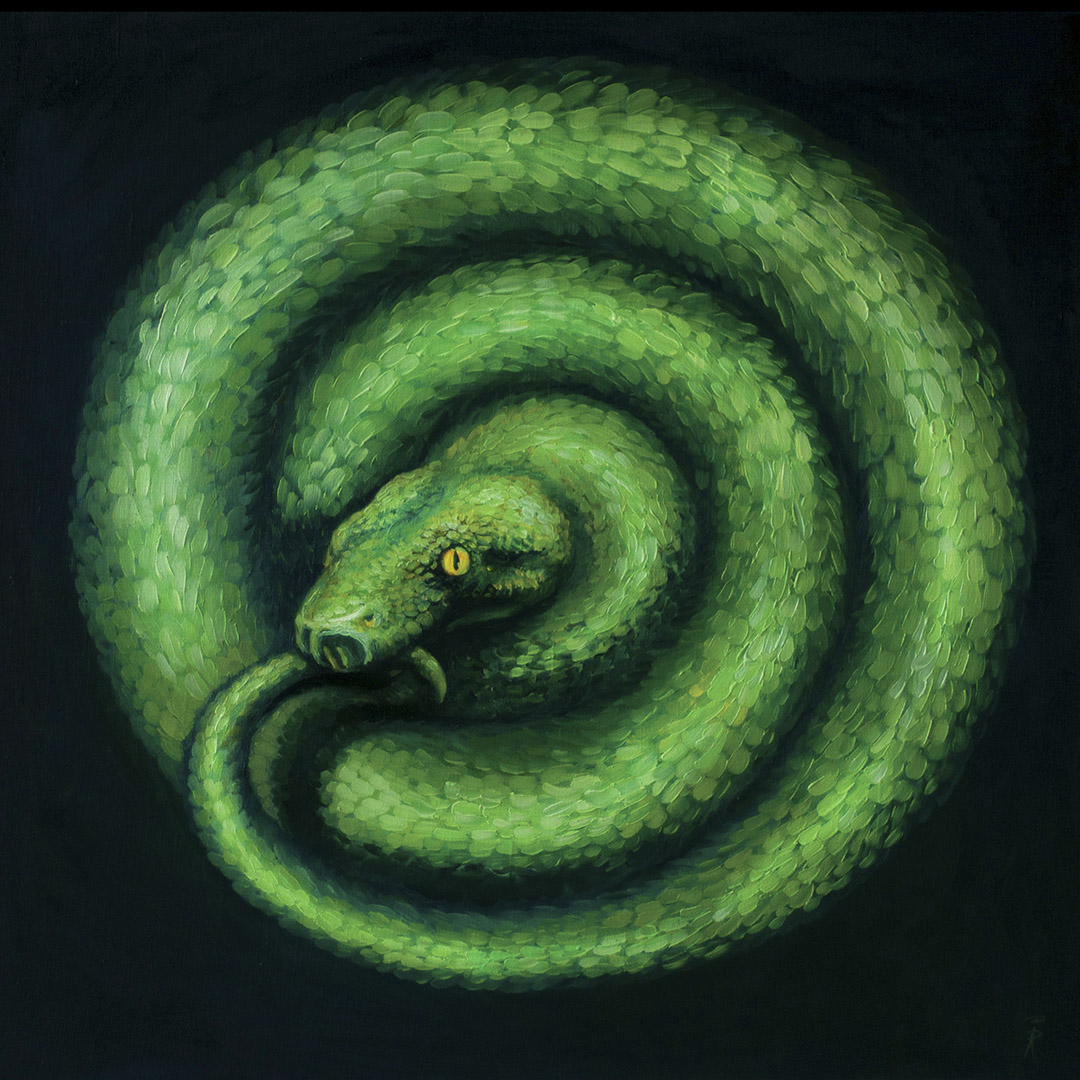
Ouroboros — the serpent devouring its own tail — is one of the ancient symbols of cyclicality, destruction, and rebirth.
Placed next to the labyrinth, it acquires another dimension. A path that seems to move forward may unexpectedly return to a familiar point. Repetition does not necessarily mean failure: when a person reaches the same place again, the person himself may already have changed.
The closed circle therefore becomes not only an image of endless recurrence, but also the possibility of a new beginning.
History moves in circles — or perhaps in a spiral, returning to familiar states at a different level.
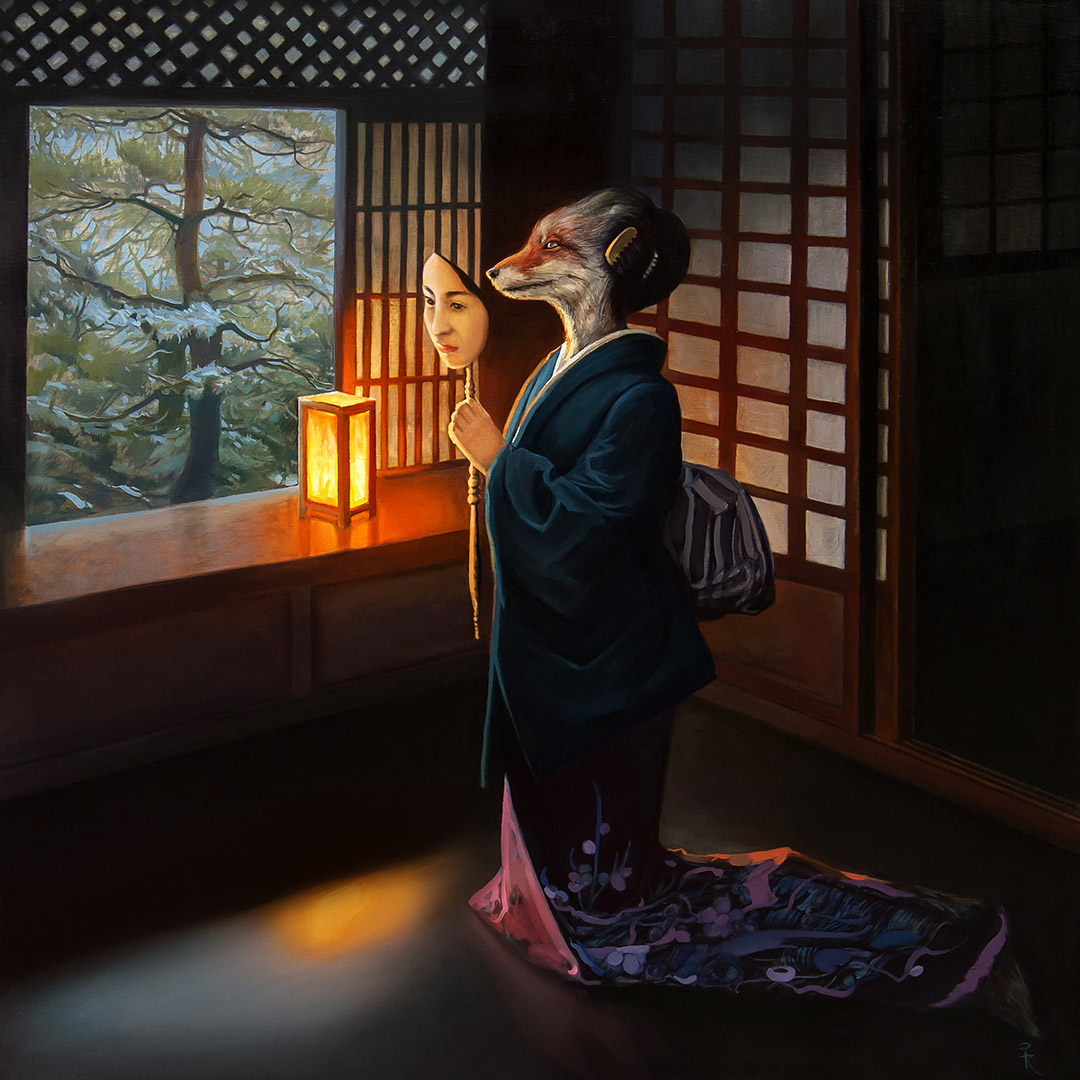
In Japanese folklore, the idea of kitsune-tsuki — fox possession — describes a state in which human and fox consciousness seem to coexist within one body.
If the first painting shows kitsune moving toward the human world, this one turns back toward her own nature. The figure is patient, watchful, capable of waiting, preparing, and enchanting. The human appearance remains part of the game, but no longer requires a complete renunciation of self.
This work is about the persistence of inner nature. Transformation may allow the fox to come closer to a human being, but it does not make her human. Behind the visible form remains another consciousness, another sense of time, and another purpose.
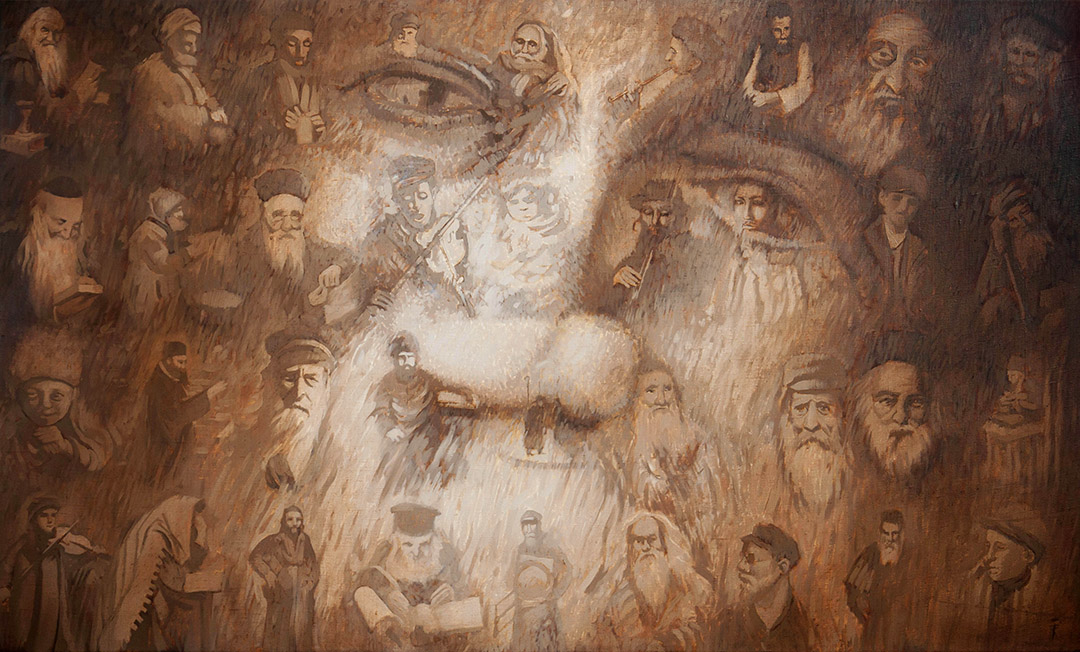
According to Jewish mystical tradition, thirty-six hidden righteous people always exist in the world. Because of them, the world continues to endure. They live among ordinary people, do not know one another, and above all do not know their own role.
For us, this ignorance became the central element of the image.
The Lamed Vavniks do not perform their task consciously and expect no recognition. They simply live, unaware that, according to legend, the world rests upon their existence.
In the painting they are gathered into a kind of “ark,” an imagined space in which the necessary balance is preserved. Yet the figures shown are only one possible fantasy. A true hidden righteous person cannot be recognized by appearance, status, or behavior.
Perhaps this is what makes the legend so compelling: the possibility that the salvation of the world may be hidden somewhere very close to us, without ever announcing itself.
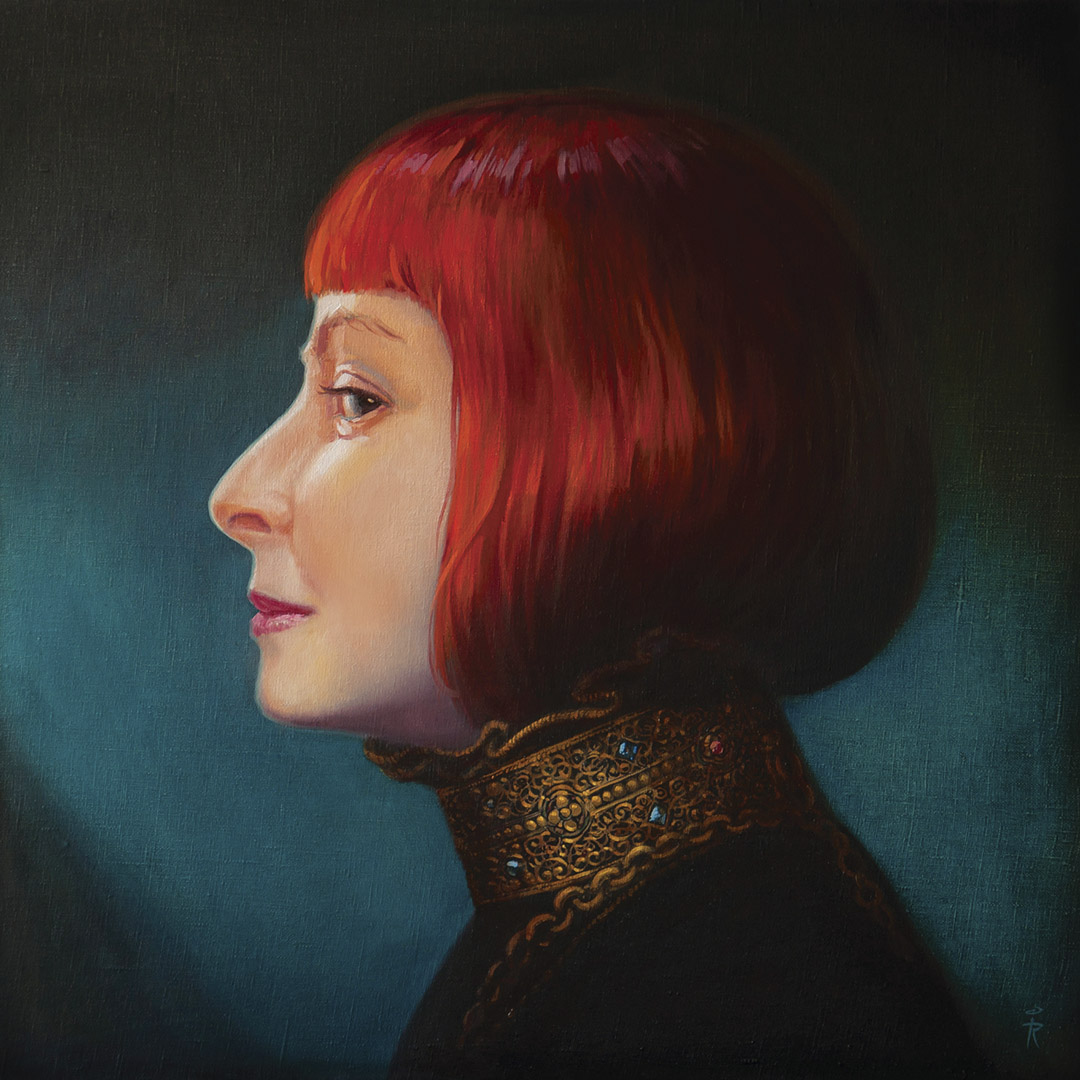
The image of Elizabeth Báthory has long existed almost independently from her historical biography. Over time, she became the “Blood Countess” — a figure suspended somewhere between historical person, serial killer, and vampire myth.
In this work, the interest lies not in delivering a new verdict, but in the distance between a person and the legend built around her. A powerful, educated, wealthy woman could easily become vulnerable within a world shaped by political, religious, and property conflicts.
The painting asks where biography ends and myth begins. How much of the image we inherit belongs to Báthory herself, and how much to the fears, interests, and fantasies of those who told her story?
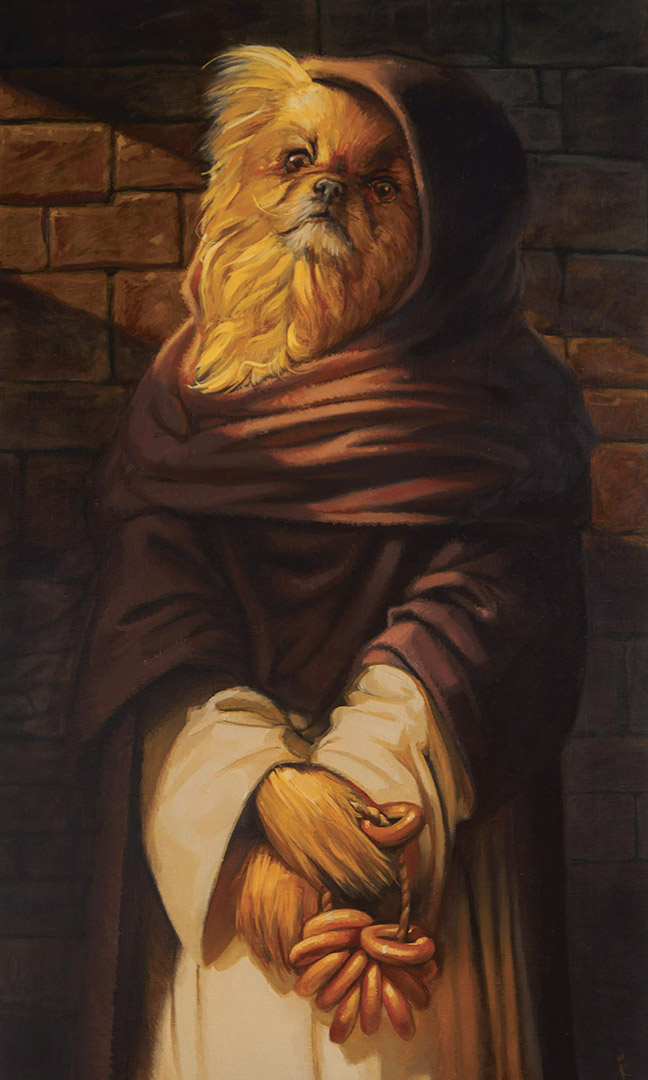
Images of dog-headed people appear in many cultures, medieval texts, and old maps. Cynocephali were imagined as inhabitants of distant lands and also entered religious and legendary traditions. One particularly striking association is the tradition in which Saint Christopher was depicted with a dog’s head.
In Diatonic Garden, this ancient and slightly frightening image unexpectedly acquired a very domestic incarnation.
The prototype of our dog-headed figure was Masya, one of the members of the family — an intelligent dog with her own habits, games, and almost ritual behaviors. One of her particular passions was bagels: she collected them, distinguished between them, and treated them like personal treasures.
In this way, an ancient mythical creature turns into a private family legend. The frightening inhabitant of medieval stories becomes recognizable, humorous, and almost human.
The boundary between myth and everyday life turns out to be much thinner than it seems.
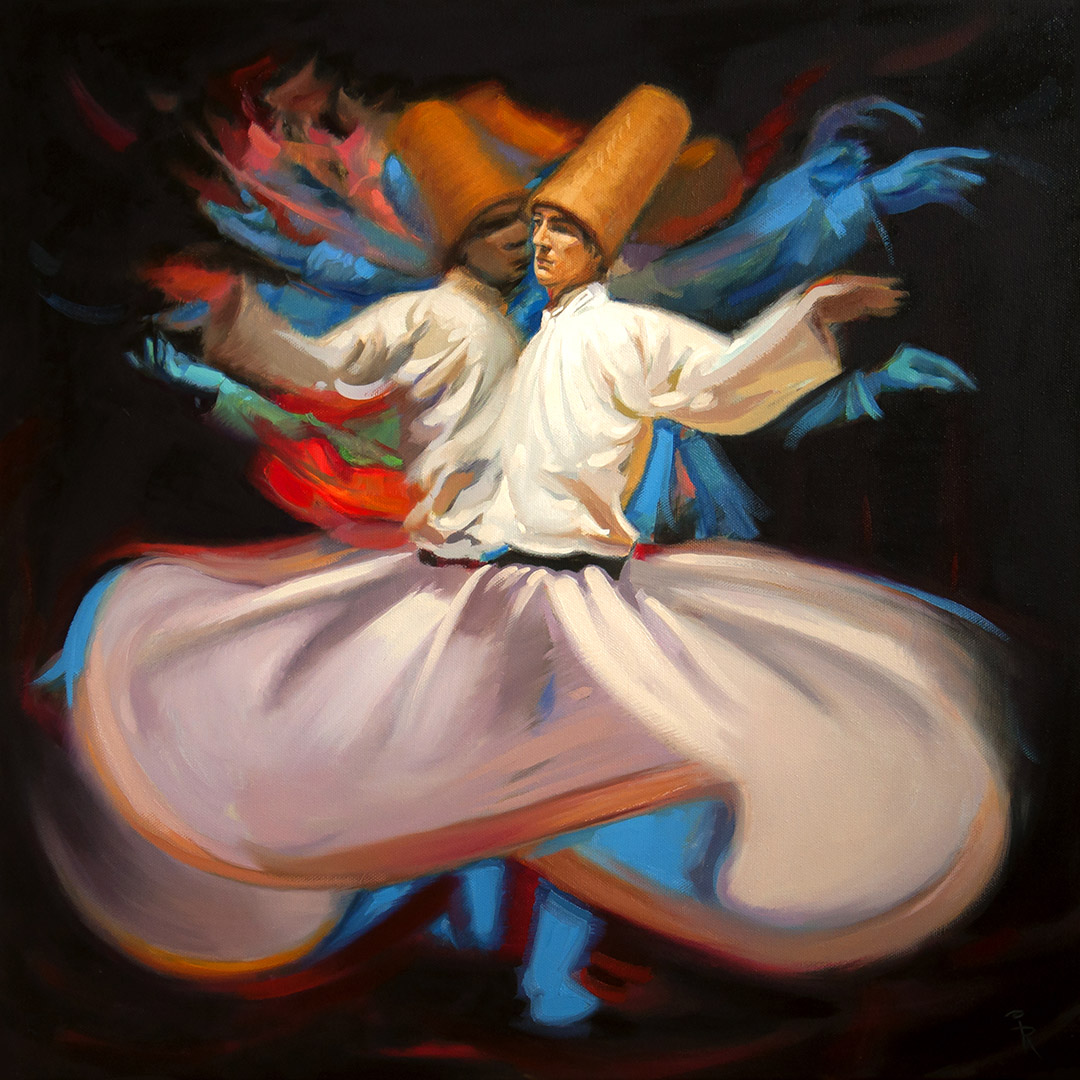
In Sufi tradition, the Qutb is the spiritual “pole” or center of the world. Unlike the thirty-six Lamed Vavniks, there is only one Qutb.
The work appeared next to Lamed Vavniks because of the unexpected similarity between the two traditions. One speaks of thirty-six hidden righteous people, the other of a single spiritual center. The cultures, languages, numbers, and religious systems differ, but the human need behind them seems remarkably similar: to imagine that somewhere there are figures who keep the world from falling apart completely.
In Diatonic Garden, thirty-six and one stand side by side. Not as opposing religious symbols, but as two versions of the same hope — that human imperfection is somehow counterbalanced.
Here, 36 + 1 becomes an image of reconciliation rather than arithmetic.
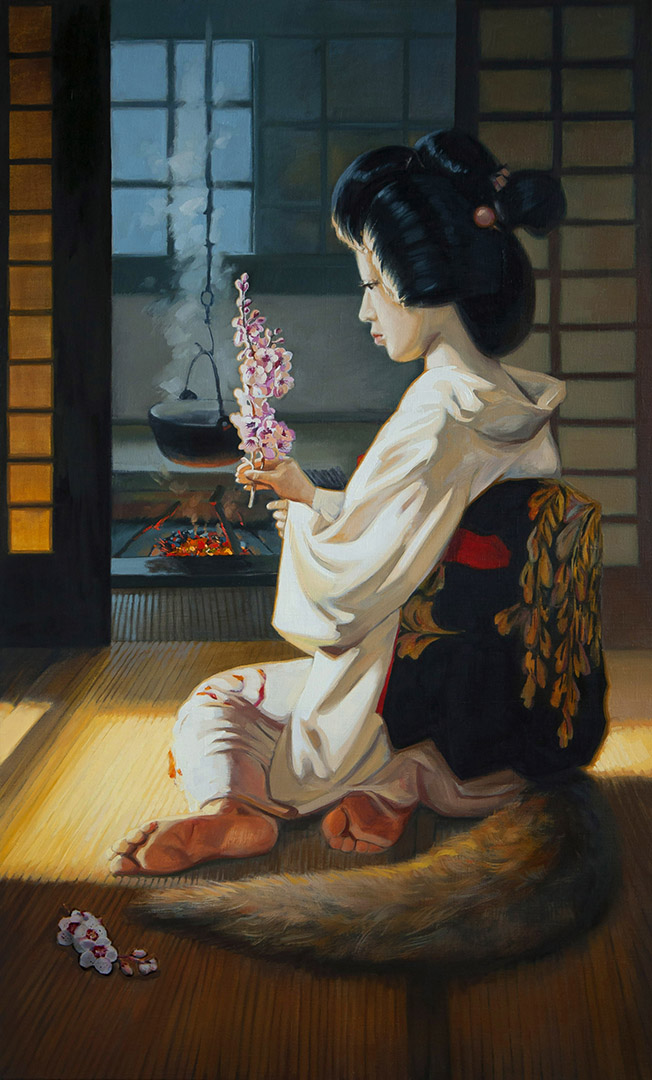
In one well-known Japanese legend, a fox takes human form, becomes a man’s wife, and bears him a child. When her secret is revealed, the husband still asks her to return to him at night. This story became the starting point for the painting.
Here kitsune is no longer the familiar cunning deceiver. She crosses the threshold of a human home herself and willingly places her fate in another person’s hands. In order to remain close to the one she loves, she has to conceal — and perhaps gradually abandon — her own nature.
But who is really wearing the mask: the wild fox pretending to be a woman, or the woman in whom the forest creature still survives? The painting becomes an image of a double life — the outward identity accepted for another person, and the inner one that can never be completely erased.